
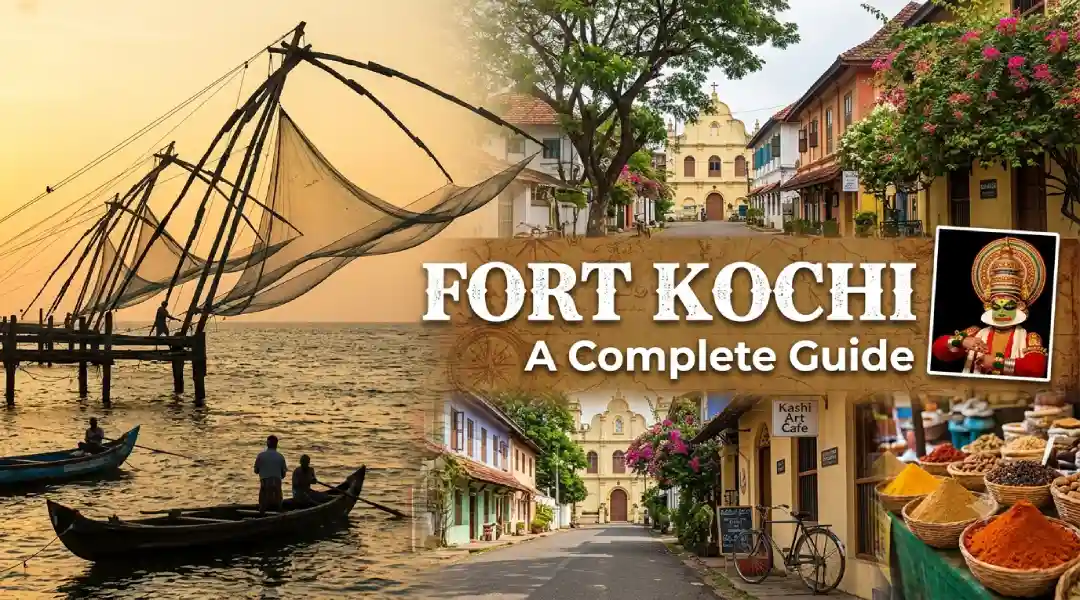

Quick answer: Most Kerala itineraries treat Kochi as the airport you land at, not a destination — that undersells it badly. Fort Kochi, the historic peninsula at the city’s edge, packs four centuries of Portuguese, Dutch, and British colonial layers, a centuries-old Jewish quarter, the iconic Chinese fishing nets, and a genuine contemporary art scene into an area small enough to walk in a single day. It deserves a dedicated stop, not a rushed layover.
If Kerala planning has you treating Kochi purely as a gateway city, here’s what you’d be skipping.
At a Glance
| Site | What It Is | Time Needed |
|---|---|---|
| Chinese Fishing Nets | Iconic cantilevered shore-fishing nets | 20-30 min, best at sunset |
| St. Francis Church | India’s oldest European church, Vasco da Gama’s original burial site | 20-30 min |
| Paradesi Synagogue & Jew Town | Historic 1568 synagogue, antique shops, spice streets | 45-60 min |
| Mattancherry (Dutch) Palace | Royal murals depicting the Ramayana | 30-45 min |
| Santa Cruz Basilica | Gothic architecture, painted ceiling | 20 min |
| Art cafés & street art | Kashi Art Café, Pepper House, gallery spaces | Flexible |
A Layered History in One Small Peninsula
Fort Kochi’s compact size is what makes it work as a walkable day — but the history packed into that space is genuinely dense. The Portuguese arrived first and built the original fort and church in the early 1500s; the Dutch took over in the 17th century and left their own architectural stamp (including converting St. Francis Church into a Dutch government church); the British followed after that. Layer on a Jewish trading community that predates all three colonial powers, and Fort Kochi ends up as one of the more genuinely multicultural historic quarters anywhere in India.
The Chinese Fishing Nets
These massive, cantilevered shore-fishing nets are Fort Kochi’s most photographed symbol — set up on tall wooden poles and requiring several people to operate. Their exact origin is more legend than settled history: some accounts credit Chinese traders from the court of Kublai Khan, others attribute them to Portuguese traders arriving via Macau, sometime in the 14th-15th century. Whichever version is accurate, they’re still in daily operation, and the best time to see them is sunset, when the silhouettes against the Arabian Sea are the reason most people bring a camera to Fort Kochi in the first place.
St. Francis Church: Where Vasco da Gama Was Actually Buried
Built by the Portuguese in 1503, St. Francis Church holds the title of India’s oldest European church. Explorer Vasco da Gama died in Fort Kochi on Christmas Eve, 1524, during his third voyage to India, and was buried here — his remains were moved to Lisbon roughly 14 years later, but the original gravestone marker remains inside. Entry is free, and the church is typically open 9 AM-5 PM on weekdays with shorter Saturday hours; a Sunday worship service means tourist access may pause during that time.
Jew Town and the Paradesi Synagogue
A short walk or auto-ride into Mattancherry brings you to Jew Town — narrow lanes lined with antique shops and spice traders, centered on the Paradesi Synagogue, built in 1568 and counted among the oldest synagogues in the Commonwealth. Kochi’s Jewish community once numbered in the thousands during its trading peak; today, only a handful of members remain, most having emigrated to Israel by the mid-20th century. It’s a genuinely poignant stop as much as a historic one.
Mattancherry Palace (The Dutch Palace)
Despite the name, this palace was originally built by the Portuguese and later renovated by the Dutch — hence the common “Dutch Palace” label. Inside, elaborate murals depicting scenes from the Ramayana and royal court life cover the walls, offering a level of detail that’s easy to spend a genuine half-hour studying.
The Modern Layer: Art Cafés and Street Art
Fort Kochi isn’t frozen in colonial history — it’s also home to a real contemporary art scene, with cafés like Kashi Art Café and spaces like Pepper House serving as informal galleries alongside their coffee. Colorful street art has spread through several lanes in recent years, giving the old town a modern layer worth wandering through between the historic stops.
A Suggested Half-Day Heritage Walk
- Start: Vasco da Gama Square, for your first look at the Chinese fishing nets
- Walk: Along Church Road to St. Francis Church
- Continue: Past the Dutch Cemetery and the ruined walls of Fort Immanuel
- Detour: To Bastion Street for Santa Cruz Basilica
- Finish: Mattancherry — Jew Town, the Paradesi Synagogue, and the Dutch Palace
This route covers the essential stops on foot, roughly matching how most repeat visitors structure their day.
How Much Time Does Fort Kochi Actually Need?
A focused half-day covers the essentials — fishing nets, St. Francis Church, and either Jew Town or the Dutch Palace. A full day allows all of the above plus unhurried time in the art cafés and street art lanes. If your Kerala itinerary allows it, an overnight stay lets you catch the fishing nets at both sunset and the following sunrise, when the old town is at its quietest.
Frequently Asked Questions
Is Fort Kochi worth visiting if I’m just passing through the airport?
Yes — it’s worth treating as a genuine stop rather than skipping straight to your next destination. Even a half-day covers the essential sights and gives real texture to a Kerala trip that otherwise might not include any city time at all.
What’s the best time of day to see the Chinese fishing nets?
Sunset, when the nets’ silhouettes against the Arabian Sea create the classic photograph most visitors come for. Early morning is a quieter, less crowded alternative.
Is St. Francis Church free to visit?
Yes, entry is free. It’s typically open 9 AM-5 PM on weekdays, with shorter hours on Saturday, and a Sunday service that may pause tourist access.
Did the Chinese really build the fishing nets, or is that just a legend?
It’s genuinely disputed — some accounts credit Chinese traders, others Portuguese traders from Macau. Most sources present it as legend rather than confirmed history, so it’s worth enjoying as local lore rather than treating either version as settled fact.
Planning Your Trip
Fort Kochi works well as either a standalone city day or the opening chapter of a longer Kerala trip — see our full guide to Kerala’s best places to visit for how it fits alongside Munnar, Alleppey, and the rest of a classic itinerary.
Planning a Kerala trip that actually includes Fort Kochi?
Talk to NVR Travels about building it into your itinerary — browse current Kerala packages to compare options.
0 Comment