
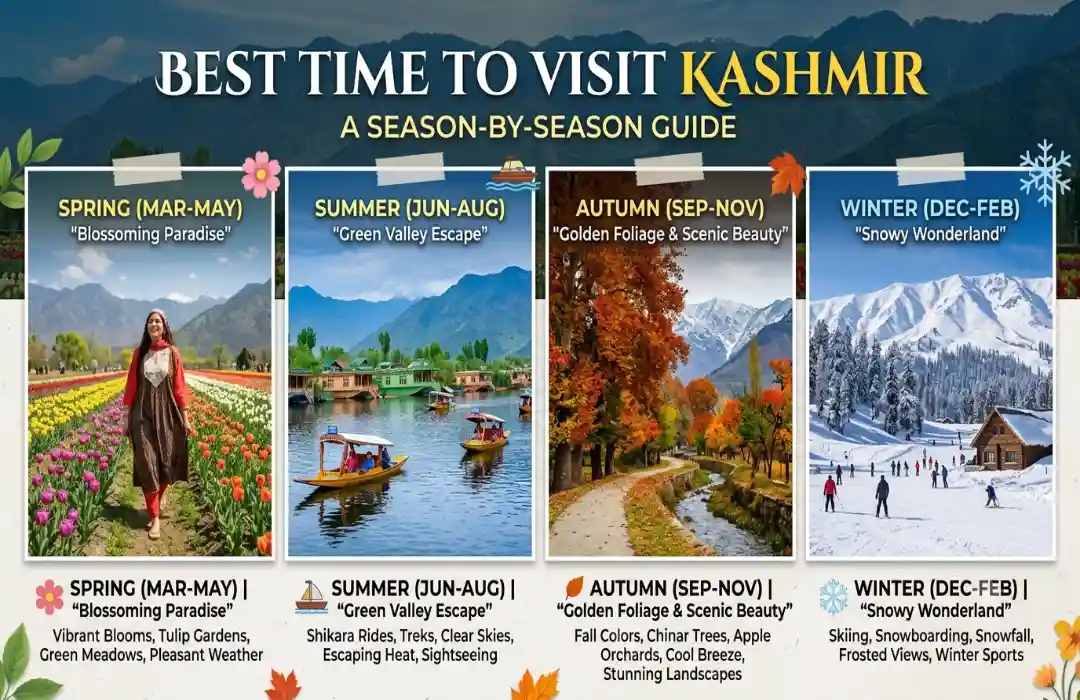

Quick answer: Kashmir has four genuinely distinct seasons, not just “good” and “bad” weather. Spring (March-May) brings the famous tulip bloom and mild weather; summer (June-August) is peak season and the most popular escape from mainland India’s heat; autumn (September-November) offers Chinar-leaf colour and thinner crowds; winter (December-February) means snow, sub-zero cold, and Gulmarg’s ski season. For most first-time visitors, April or late September-October hit the best balance of good weather and manageable crowds.
If you’re planning a trip to Srinagar and the wider Kashmir circuit, the season you choose changes the trip almost entirely — here’s how each one actually plays out.
At a Glance
| Season | Months | Srinagar Temp | Signature Experience | Crowd Level |
|---|---|---|---|---|
| Spring | March–May | approx. 4–24°C | Tulip Garden bloom, mild weather | Moderate, rising through April |
| Summer | June–August | approx. 15–30°C | Dal Lake, Mughal gardens, Amarnath Yatra | Highest of the year |
| Autumn | September–November | approx. 0–25°C | Chinar leaves turning gold/red | Low — an insider favorite |
| Winter | December–February | approx. -2–10°C | Snow, Gulmarg skiing | Moderate, ski-focused |
Spring (March–May): Tulips and Mild Weather
This is Kashmir’s most photogenic short window. The Indira Gandhi Memorial Tulip Garden — officially recognized as Asia’s largest — opens in mid-March and typically reaches full bloom across its 70-plus tulip varieties by early-to-mid April, set against the Zabarwan hills with Dal Lake below. The bloom only lasts a few weeks each year, so if the tulip garden is a priority, it’s worth checking that year’s exact opening date rather than assuming it matches the previous year.
Beyond the tulips, spring weather is genuinely pleasant — mild enough for sightseeing without summer’s peak crowds.
Best for: First-time visitors who want good weather and the tulip bloom without full summer congestion.
Summer (June–August): Peak Season, Escape the Heat
This is Kashmir’s busiest season by a clear margin, largely because it’s the go-to escape from the heat across the rest of India. Dal Lake shikara rides, the Mughal gardens in full bloom, and Gulmarg’s green (rather than snow-covered) meadows are all at their best.
One thing worth planning around: the Amarnath Yatra pilgrimage typically runs through part of this window, which noticeably increases footfall and hotel demand around Pahalgam specifically, since it’s a key transit point. If your route passes through Pahalgam during peak Yatra weeks, book accommodation well ahead.
Best for: Travelers prioritizing warm, reliable weather over avoiding crowds — and anyone specifically escaping plains-level summer heat.
Autumn (September–November): Chinar Season, Fewer Crowds
Often the season repeat visitors and photographers quietly prefer. Kashmir’s Chinar trees — especially around Naseem Bagh and the Mughal gardens — turn a dramatic gold and red through October, while crowds thin out noticeably compared to summer. Weather stays cool and crisp rather than cold.
Best for: Travelers who’ve done the “classic” Kashmir trip before and want a quieter, more atmospheric version — or photographers chasing the Chinar colour specifically.
Winter (December–February): Snow and Gulmarg Skiing
Winter brings Kashmir’s harshest stretch, locally known as Chillai Kalan — the roughly 40-day period from late December to early February when the coldest temperatures of the year typically hit. Srinagar itself sees snow, and Dal Lake has been known to partially freeze during severe cold spells.
Gulmarg is the season’s main draw, transforming into a proper ski destination with access via one of the highest cable car systems in Asia. Mughal garden sightseeing takes a back seat this time of year since the gardens are dormant, but the snow scenery more than compensates for travelers who come for that specifically.
Best for: Ski and snowboard enthusiasts, honeymooners wanting a winter-romance setting, and travelers who specifically want snow over garden sightseeing.
Month-by-Month Snapshot
| Month | Srinagar Temp (approx.) | What’s Happening |
|---|---|---|
| January | -2–8°C | Peak Chillai Kalan cold, Gulmarg ski season |
| February | 0–10°C | Still cold, skiing continues |
| March | 4–15°C | Tulip Garden opens mid-month |
| April | 8–20°C | Peak tulip bloom, mild and pleasant |
| May | 12–24°C | Warming up, gardens in full bloom |
| June | 15–28°C | Summer begins, Yatra season starts |
| July | 18–30°C | Warmest month, peak tourist season |
| August | 17–29°C | Still peak season, Yatra continues |
| September | 12–25°C | Crowds thin, early Chinar colour |
| October | 6–20°C | Peak Chinar foliage, cooler evenings |
| November | 0–14°C | Cooling fast, early snow possible |
| December | -2–8°C | Snow begins, Chillai Kalan starts ~Dec 21 |
Which Season Fits Your Trip?
- Want the tulip bloom specifically: Late March to mid-April, dates confirmed closer to travel
- Escaping summer heat, don’t mind crowds: June–August, book Pahalgam-area stays early if traveling during Yatra season
- Want fewer crowds and still-good weather: September–October
- Want snow, skiing, or a winter honeymoon setting: December–February, centered on Gulmarg
- First trip, want the best all-round balance: April or late September
Frequently Asked Questions
When do the Kashmir tulips actually bloom? The Tulip Garden typically opens in mid-March, with peak bloom across all varieties usually falling in the first half of April. The exact dates shift slightly each year depending on that winter’s temperatures, so it’s worth a quick check closer to your travel dates rather than assuming fixed dates.
Is Kashmir safe to visit? Kashmir’s tourist circuit — Srinagar, Gulmarg, and Pahalgam — sees large numbers of domestic and international visitors every year, with well-established tourism infrastructure. As with any trip, it’s worth checking current travel advisories closer to your dates, since on-the-ground conditions can change.
What’s the coldest month in Kashmir? January is typically the coldest, falling within the Chillai Kalan period — the roughly 40-day harshest stretch of winter that runs from late December into early February.
Can you visit Kashmir during monsoon season? Kashmir doesn’t experience the heavy monsoon rainfall that much of mainland India does — summer here brings warm, mostly pleasant weather rather than the sustained monsoon pattern found elsewhere, making June-August a genuinely good window rather than one to avoid for rain reasons.
Planning Your Trip
Once you’ve picked a season, the next decision is how to split time between Srinagar, Gulmarg, and Pahalgam — each has a different rhythm depending on the time of year you’re visiting.
Planning a Kashmir trip? Talk to NVR Travels about a season-matched itinerary — browse current Kashmir packages to compare options.
0 Comment