
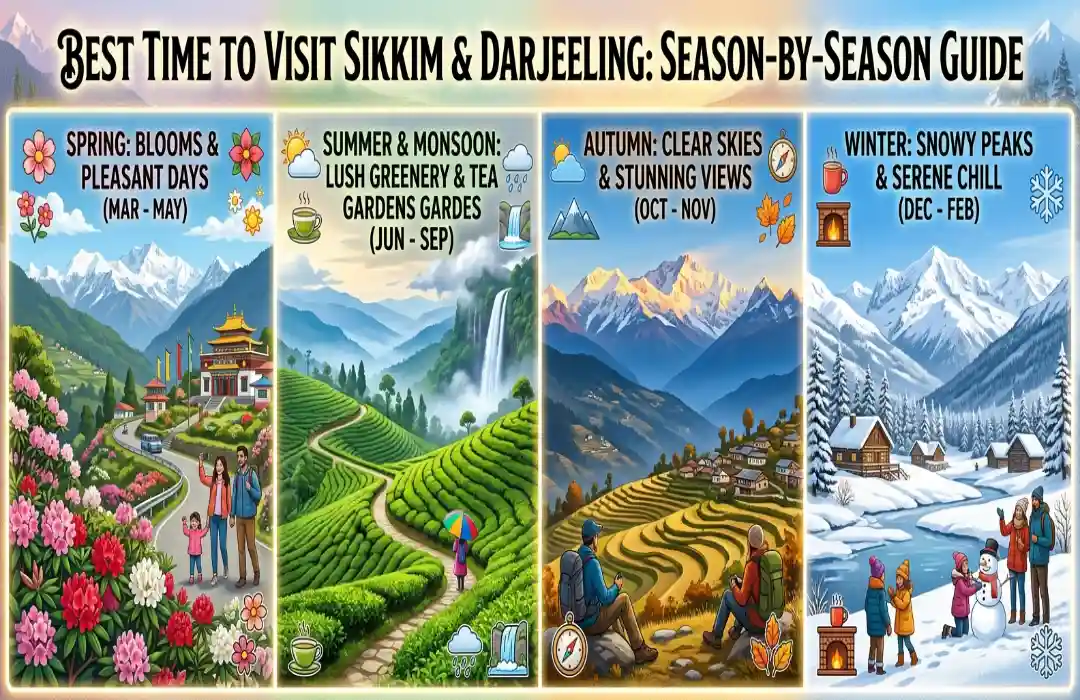

Quick answer: Spring (March-May) brings Yumthang Valley’s rhododendron bloom and Darjeeling’s first-flush tea season. Monsoon (June-September) brings heavy rain and real landslide risk on mountain roads — worth avoiding for a first trip. Autumn (October-November) usually delivers the clearest Kanchenjunga views of the year. Winter (December-February) is quiet and cold, with Yumthang Valley closed entirely due to snow.
Sikkim and Darjeeling sit close enough together to combine easily, but their best season overlaps more than it diverges — here’s how the year actually breaks down.
At a Glance
| Season | Months | Sikkim Highlight | Darjeeling Highlight | Access Notes |
|---|---|---|---|---|
| Spring | March–May | Yumthang rhododendron bloom | First-flush tea season | Nathula Pass at its best |
| Monsoon | June–September | Heavy rain, limited access | Kanchenjunga often hidden in cloud | Landslide risk on mountain roads |
| Autumn | October–November | Nathula clear-weather window | Clearest Kanchenjunga views of the year | Widely considered the best overall season |
| Winter | December–February | Yumthang closed (snow) | Cold but open, toy train still runs | Nathula may close in heavy snow |
Spring (March–May): Rhododendron Season
This is when Yumthang Valley — Sikkim’s “Valley of Flowers” — earns its name. Over 24 rhododendron species across the Shingba Rhododendron Sanctuary bloom from late February through mid-June, with the display typically at its fullest through April and May. Nathula Pass also sees some of its clearest, most pleasant weather in this window, making it a strong period for both destinations at once.
On the Darjeeling side, this is first-flush tea season — the year’s earliest and most prized harvest, worth timing a tea-garden visit around if that’s a priority.
Best for: First-time visitors who want the rhododendron bloom and reasonably clear mountain views without monsoon risk.
Monsoon (June–September): The Season to Plan Around, Not During
Heavy rainfall hits both Sikkim and Darjeeling hard in these months, and mountain roads connecting Gangtok, Darjeeling, and North Sikkim become genuinely more prone to landslides after sustained rain. Kanchenjunga views from Tiger Hill and Pelling are frequently obscured by cloud cover, undercutting one of the region’s biggest draws.
Best for: Almost no one — this is the one season worth actively avoiding unless your travel dates are completely fixed, and if they are, build in flexible buffer days for road conditions.
Autumn (October–November): The Region’s Best-Kept Secret
Post-monsoon clarity makes October-November the season serious photographers and repeat visitors tend to prefer. Kanchenjunga views from Tiger Hill are typically at their sharpest, Nathula Pass sees another clear-weather window, and crowds are noticeably thinner than spring’s peak season.
Best for: Travelers prioritizing mountain visibility and a quieter trip over the specific rhododendron bloom.
Winter (December–February): Quiet, Cold, and Partially Closed
Yumthang Valley closes entirely between December and March due to heavy snowfall, and Nathula Pass can close on short notice during major snow events. Darjeeling and Gangtok towns themselves remain open and reachable, with the toy train still running — this is a genuinely different, quieter version of the region rather than a write-off season.
Best for: Budget-conscious travelers comfortable skipping Yumthang and Nathula, who want a quiet trip centered on Darjeeling and Gangtok town themselves.
Which Season Fits Your Trip?
- Want the rhododendron bloom specifically: April–May
- Want the clearest possible Kanchenjunga views: October–November
- Want Nathula Pass at its best: April–June or October–November
- Comfortable skipping Yumthang and Nathula for a quieter, cheaper trip: December–February
- First-time visitor wanting the safest all-round bet: October–November
Frequently Asked Questions
When exactly do the Yumthang Valley rhododendrons bloom? The flowering season runs from late February through mid-June, with peak bloom typically in April and May. The valley itself is closed to visitors from December through March due to heavy snowfall.
Is Nathula Pass open every day of the week? No — Nathula is typically open Wednesday through Sunday and closed on Mondays and Tuesdays, in addition to closing during heavy snowfall in winter. Worth confirming current visiting days before finalizing your itinerary.
Do tourists need special permits for Sikkim? Yes, in most cases. Indian citizens generally need an Inner Line Permit to enter Sikkim, arranged easily through a travel agent or at the check post. Restricted areas like Nathula Pass and Tsomgo Lake require an additional Protected Area Permit, and requirements can differ for foreign nationals — worth confirming current rules with your operator before travel.
Can you see Kanchenjunga from Darjeeling during monsoon? Rarely with any reliability — heavy cloud cover through June-September frequently obscures the view that Tiger Hill and similar viewpoints are known for. Autumn and spring offer far better odds.
Planning Your Trip
Once you’ve picked a season, the next question is how to split time between Sikkim and Darjeeling — each has its own rhythm depending on when you’re visiting.
Planning a Sikkim-Darjeeling trip? Talk to NVR Travels about a season-matched itinerary — browse current Sikkim-Darjeeling packages to compare options.
0 Comment